Long Island Demographics

Long Island is one of the most densely populated regions in the United States. As of the United States 2010 Census, the total population of all four counties of Long Island was 7,568,304, which is 39 percent of the population of the State of New York. New York City’s portion of the census was 4,735,538, with Brooklyn’s population at 2,504,700 and Queens having 2,230,722 residents.

The combined population of Nassau and Suffolk counties was 2,832,882 people; Suffolk County’s share at 1,493,350 and Nassau County’s at 1,339,532. Nassau County had a larger population for decades, but Suffolk County surpassed it in the 1990 census as growth and development continued to spread eastward.

As Suffolk County has over twice the land area of Nassau County, the latter still has a much higher population density. Combining all four counties, Long Island’s population is greater than 38 of the 50 United States. If it were an independent nation, Long Island would rank as the 96th most populated nation, falling between Switzerland and Israel.

Population figures from the U.S. Census Bureau Census 2010 show that whites are the largest racial group in all four counties, and are in the majority in Nassau and Suffolk counties. In 2002, the New York Times cited a study by the non-profit group ERASE Racism, which determined that Nassau and Suffolk counties are the most racially segregated suburbs in the United States.

Catholics are the largest religious group on Long Island, with non-affiliated in second place. Catholics make up 52% of the population of Nassau and Suffolk, versus 22% for the country as a whole, with Jews at 16% and 7% respectively versus 1.7% nationwide. Even more surprising is the small percentage of Protestants, 7% and 8% respectively, for Nassau and Suffolk Counties, versus 23% for the entire country on the same survey, and 50% on self-identification surveys.

Long Island has a substantial Italian-American population. About 26% of Long Island residents claim Italian ancestry. 28% of Suffolk County residents claim Italian ancestry.

More recently, a Little India has emerged in Hicksville.

A 2010 New York Times article stated that the expansion of the immigrant workforce on Long Island has not displaced any jobs from other Long Island residents, and that, in fact, half the immigrants on Long Island hold white-collar positions.

  • Digg
  • Del.icio.us
  • StumbleUpon
  • Reddit
  • Twitter
  • RSS

Education

Education

Primary and secondary education

Long Island’s Nassau and Suffolk counties are home to 125 public school districts containing a total of 656 public schools. In contrast, all of Brooklyn and Queens are served by the New York City Department of Education, the largest school district in the United States. Long Island is also home to a number of private and parochial schools.

Colleges and universities

Nassau and Suffolk counties are home to numerous colleges and universities, including:

Public:

  • institutions of the State University of New York
    • Stony Brook University, including the main Stony Brook campus and the Stony Brook Southampton campus
    • SUNY College at Old Westbury
    • Farmingdale State College (Farmingdale)
    • Nassau Community College (East Garden City)
    • Suffolk County Community College – three main campuses: in Selden, Brentwood, and Riverhead; plus two “satellite” centers in Sayville and downtown Riverhead
  • Federal Service Academies
    • United States Merchant Marine Academy (Kings Point)

Private:

  • Adelphi University in Nassau County (main campus in Garden City) and Suffolk County (an Education and Conference Center in Hauppauge)
  • Briarcliffe College – in Queens at Long Island City; Nassau at Bethpage; and Suffolk at Patchogue
  • Dowling College – three campuses in Suffolk County (Oakdale, Shirley, and Melville)
  • Five Towns College in Suffolk County (Dix Hills)
  • Hofstra University in Nassau County (Hempstead and Uniondale)
  • Long Island University: C.W. Post Campus in Brookville in Nassau County, and two branch campuses in Suffolk County at Brentwood and Riverhead, as well as a Brooklyn campus
  • Molloy College – in Nassau County (Rockville Centre)
  • New York Institute of Technology – main campus in Nassau (Old Westbury), campus also in Suffolk (Central Islip) and Manhattan
  • Polytechnic Institute of New York University (formerly Polytechnic University, now part of NYU) – has a “Long Island Graduate Center” in Suffolk, at Melville, as well as the main campus in Brooklyn
  • Saint John’s University – Main campus in Queens, with a graduate center in Suffolk (Oakdale)
  • Saint Joseph’s College – campuses in Brooklyn and Suffolk (Patchogue)
  • SBI-Melville – Sanford-Brown Institute campus in Suffolk County at Melville
  • Touro Law Center in Suffolk County (Central Islip)
  • Watson School of Biological Sciences in Nassau County (Laurel Hollow)
  • Webb Institute in Nassau County (Glen Cove)
  • Digg
  • Del.icio.us
  • StumbleUpon
  • Reddit
  • Twitter
  • RSS

Long Island Weather

Long Island has a climate that is very similar to other coastal areas of the Northeastern United States; it has warm, humid summers and cold winters, but the Atlantic Ocean helps bring afternoon sea breezes that temper the heat in the warmer months and limit the frequency and severity of thunderstorms. In the wintertime, temperatures are warmer than areas further inland (especially in the night and early morning hours), sometimes causing a snowstorm further inland to fall as rain on the island. However, measurable snow falls every winter, and in many winters one or more intense storms called nor’easters produce blizzard conditions with snowfalls of 1-2 feet and near-hurricane force winds.

Temperatures in Nassau and Suffolk are similar. The winter average for Nassau is 33.7 degrees Fahrenheit, compared to a summer average of 72.7 degrees. In Suffolk, the winter average is 32.4 and summer average is 71.9 degrees.

The Nassau area receives about 45 inches of rain, compared to 42 inches for Suffolk. Snow falls at about 26.9 inches per year in Nassau and 30 inches for Suffolk.

  • Digg
  • Del.icio.us
  • StumbleUpon
  • Reddit
  • Twitter
  • RSS

Long Island Geography

Long Island Geography
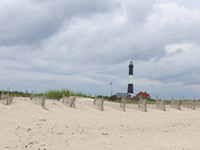
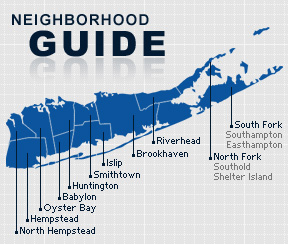
To the north of the island is Long Island Sound, which separates it from the coast of Connecticut and Rhode Island. To the south are the Great South Bay, South Oyster Bay, and Jamaica Bay, which are actually lagoons, protected from the Atlantic Ocean by a string of narrow barrier islands, most notably Fire Island. The island separates into two forks at the eastern end, known as the North Fork and South Fork.

Long Island is interesting because it is geographically part of the Mid-Atlantic, however many towns and hamlets along the island’s north shore and in eastern Suffolk County, such as Oyster Bay, Port Jefferson and Sag Harbor seem to resemble New England towns, while many of the towns and hamlets along the south shore, such as Long Beach, Valley Stream, and Babylon seem to resemble Mid-Atlantic coastal communities, especially those on the shore between New Jersey and Virginia.

Long Island can be considered the geographical border between the Mid-Atlantic and New England.

The island’s tallest point is Jayne’s Hill near Melville, with an elevation of 400.9 feet (122.2 m) above sea level. The island is separated from the mainland by the East River – actually not a river but both a tidal strait and a tidal estuary.

  • Digg
  • Del.icio.us
  • StumbleUpon
  • Reddit
  • Twitter
  • RSS

Long Island Info

Long Island is an island located in the southeast part of the U.S. state of New York, just east of Manhattan. Stretching northeast into the Atlantic Ocean, Long Island contains four counties, two of which are boroughs of New York City (Queens and Brooklyn), and two of which are mainly suburban (Nassau and Suffolk). The term “Long Island” often refers only to Nassau and Suffolk counties in order to differentiate them from New York City, though all four counties on the island are part of the New York metropolitan area.

As of the 2010 census, Long Island had a population of 7,568,304,  making it the most populated island in any U.S. state or territory. It is also the 17th most populous island in the world, ahead of Ireland, Jamaica and the Japanese island of Hokkaidō. Its population density is 5,402 inhabitants per square mile (2,086 /km2). If it were a state, Long Island would rank 13th in population (after Virginia) and first in population density.

Both the longest  and the largest island in the contiguous United States, Long Island extends 118 miles (190 km) eastward from New York Harbor to Montauk Point, and has a maximum north-to-south expanse of 23 miles (37 km) between the northern Long Island Sound coast and the southern Atlantic coast. With a land area of 1,401 square miles (3,629 km2), Long Island is the 11th largest island in the United States and the 148th largest island in the world — larger than the 1,214 square miles (3,140 km2) of the smallest state, Rhode Island.

Two of New York City’s major airports, LaGuardia Airport and JFK International Airport, are located on Long Island, in Queens. Nine bridges and 13 tunnels (including railway tunnels) connect Brooklyn and Queens (and thus Long Island) to the three other boroughs of New York City. Ferries connect Suffolk County northward across Long Island Sound to the state of Connecticut.

  • Digg
  • Del.icio.us
  • StumbleUpon
  • Reddit
  • Twitter
  • RSS